On this page
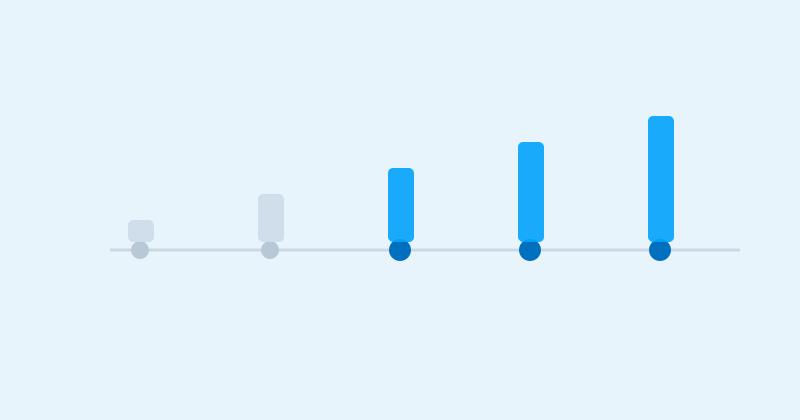
Expect very little in the first three months, the first useful signs at four to six, and a real picture at a year. The single thing that decides which way it goes is whether anybody writes anything after launch.
Three quiet months, then the first signs
Expect very little in the first three months, the first useful signs around four to six, and a real picture at a year. A brand-new domain in a small trade is at the slow end of that.
Anyone giving you a shorter number is either selling advertising, which is a different thing, or guessing.
What happens in the first month
Almost nothing visible, and that is correct rather than a problem.
In the first weeks a search engine has to find the site, crawl it, and decide what is worth keeping. On a catalogue of thousands of products that takes a while, and it happens gradually rather than in one pass.
Your home page and main pages usually appear first. Category pages follow. Product pages trickle in over a much longer period, and many never get indexed at all, which is normal for a large catalogue.
What to do in month one: connect the site to Google Search Console, submit the sitemap, and check that nothing is blocking crawling. That is the whole job.
Months two and three
Pages start being indexed in volume. You may see the first impressions in Search Console, which means your pages were shown to somebody, usually well down the results.
Traffic at this stage is close to nothing, and the searches bringing it are mostly your own company name. That is expected. Somebody searching your business name was going to find you anyway.
The useful work in this period is writing. Category pages with real content, and pages answering the questions your customers ask. Those are the pages that will carry the site later, and they need to exist before they can age.
Months four to six
This is where the first genuine signs appear.
Category pages begin ranking for narrower searches. Long specific product searches start bringing occasional visitors, and those visitors are usually close to buying. Pages you wrote yourself start outperforming pages you did not.
The pattern to watch for is not traffic volume. It is whether the searches bringing people are ones you would want. Ten visits from people searching for what you sell is a better sign than two hundred from people searching for something unrelated.
After six months
By this point the site either has momentum or it has stalled, and the difference is almost always whether anything was written.
A catalogue site that launched and was left alone will sit roughly where it was at month three. The products are indexed, they carry the same descriptions as every other reseller, and nothing distinguishes them.
A site where somebody wrote a page a month has twelve pages nobody else has, each of them ageing and accumulating. That compounds.
This is the least technical and most decisive factor in the whole process, and it is entirely in your hands.
What makes it faster
Four things genuinely help, and none of them is a trick.
Using a domain you already own. Years of history is the one advantage that cannot be manufactured. If you have an existing domain, use it.
Being linked to from somewhere real. An industry directory, a supplier listing, a chamber of commerce, a customer's site. A handful of genuine links early is worth more than anything you can buy.
Writing for occasions rather than products. Occasion searches are far less contested than product searches, so they rank sooner.
Publishing prices. Pages that answer the question get more clicks than pages that defer it, and a page nobody clicks does not hold its position.
What to do while you wait
The waiting period is where most reseller websites are lost, because nothing appears to be happening and attention moves elsewhere. Four things are worth doing in it, and none of them is technical.
Send your existing customers to it. The site does not only serve strangers. Customers who already buy from you can browse the range, check what exists and send you a specified order instead of an email. That value arrives on day one and does not depend on search at all.
Put the address everywhere it belongs. Email signatures, quotes, invoices, vehicle signage, your social profiles, any directory you are already listed in. These are the first genuine links a new site gets.
Write one page a month. Twelve pages after a year is a meaningful body of work. Nothing after a year is where most reseller sites end up, and it is the single clearest difference between the sites that work and the ones that do not.
Watch what people search, not how many. Search Console shows the queries that led to you. In the early months the volume is meaningless and the queries are informative: they tell you what you are being understood to sell.
What means something is wrong
Patience is right, but not indefinitely. Four signs mean something needs looking at rather than waiting out.
- Nothing indexed at all after two months. Something is blocking crawling. Search Console will say what.
- Only the home page indexed after three months. Your categories and products are probably not linked in a way a crawler can follow.
- Impressions but no clicks after six months. You are appearing for the wrong searches, or your titles and descriptions are not worth clicking.
- Traffic that arrived and then fell away. Worth investigating rather than assuming.
Everything else is just the time it takes.
Questions we get asked about this
Can I pay to speed this up?
Not for organic results. You can pay for advertising, which is a separate thing that stops when you stop paying. Nothing legitimate makes a new domain rank faster than it earns.
Does a new domain rank slower than an old one?
In practice yes, though not because of a rule about age. An established site has accumulated links, history and crawl attention that a new one has not, and those take time to build regardless of the domain.
Should I use an existing domain if I have one?
Usually yes. A domain you have used for years carries history a new registration does not. Keeping it and putting the new site on it is nearly always better than starting fresh.
How will I know it is working?
Register the site with Google Search Console at launch. It shows what has been indexed and what people searched before clicking, which is the only measure that reflects what is actually happening.
Last updated 9 September 2026. Sources and limits.
Put the catalogue on your own website
CatalogueConnect builds Amrod reseller websites with catalogue sync, reseller-controlled pricing and a bulk quantity grid. The website build is R18 999 once off.