On this page
- Publish what can be compared, quote what must be specified
- What a price on your website actually shows
- Why this worries South African resellers more than Americans
- What your competitors already know
- Fewer enquiries, better ones
- Three times you should not publish
- How to publish without losing room to negotiate
Publish the price of anything a customer could compare, and quote anything you would have to specify. A published price shows your selling price, not your cost or your markup, and those stay on your own server.
Publish what can be compared, quote what must be specified
Publish the price of anything a customer could compare, and quote anything you would have to specify. A golf shirt has a price. A hundred golf shirts with a left-chest embroidery, a rush deadline and delivery to two branches has a quote.
The concern is usually margin. A published product price shows the customer your selling price. Your supplier cost and markup remain separate figures in the website admin.
What a price on your website actually shows
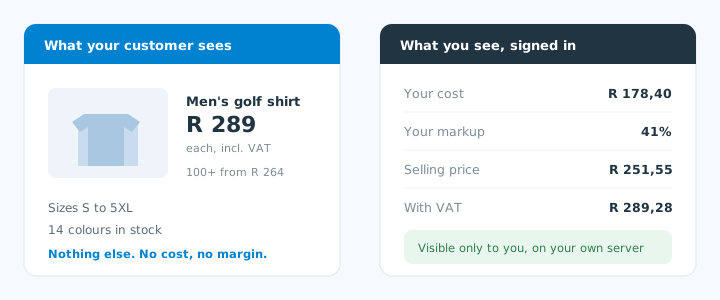
A published price shows one number: what this item costs your customer to buy from you.
It does not show what you paid. It does not show your markup percentage, your supplier, your tier, or what you charge a different customer. Those are separate figures that live in your own admin, and a properly built site never sends them to a browser at all.
This distinction matters because the two get talked about as if they were the same thing. "Putting prices on my website" sounds like opening your books. It is closer to putting a price sticker on a shelf.
Why this worries South African resellers more than Americans
There is a real reason this feels riskier here, and most of the advice you will read on it was written for a different market.
American and British promotional suppliers use coded pricing. The supplier's catalogue shows a selling price, and the distributor's cost is hidden behind a letter code printed next to it. An American distributor can hand a supplier catalogue straight to a client, because the client cannot read the cost out of it.
South African trade suppliers do not work that way. Amrod shows you your own cost, against your own loyalty tier. So the catalogue you look at every day genuinely cannot be handed to a customer, and twenty years of that habit makes "putting prices online" sound like the same act.
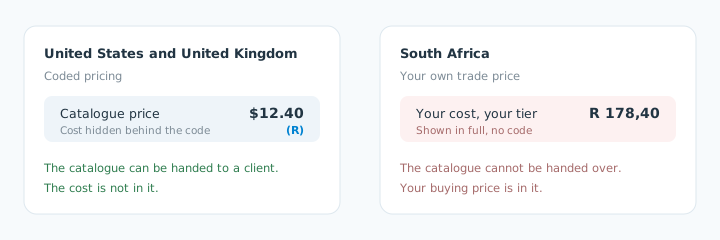
It is not the same act. Your supplier's catalogue and your own price list are two different documents, and only one of them has your cost in it.
What your competitors already know
Any competitor who wants your pricing can have it this afternoon. They phone a company that buys from you, or they send you an enquiry from a Gmail address, or they meet your customer at a golf day. In a trade this size, with the same catalogue behind everyone, your selling prices are not a secret. They are just slow to obtain.
So publishing does not hand a competitor something they could not get. It hands a customer something they could not easily get, which is a number, at the moment they were looking for one.
Fewer enquiries, better ones
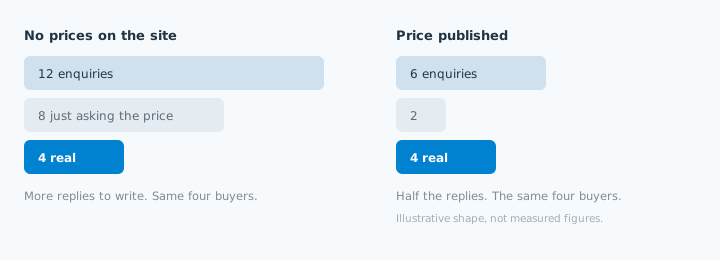
Publishing prices usually reduces the number of enquiries you receive. That sounds bad and mostly is not.
The enquiries it removes are the ones that were only ever asking the price. Somebody wanted a ballpark, you spent twenty minutes building a quote, and they never replied because the number was three times their budget. Neither of you was ever going to do business.
The enquiries it keeps are from people who have seen the number, accepted it, and are contacting you about a job. That is a different conversation, and it starts further along.
There is one real cost. You lose the chance to size the price to the customer after you have judged them. Some resellers price a corporate differently from a school. If that is central to how you make money, read the next section carefully.
Three times you should not publish
When the specification decides the price. If a job's cost depends on branding positions, artwork condition, quantities across sizes and a deadline, a published unit price is a number you will spend the call walking back. Publish the garment. Quote the job.
When you hold a genuinely better buying price. If your tier or your volume gets you a cost your competitors cannot match, your price is a competitive weapon and there is an argument for holding it back until you are in the conversation. Note that this is rarer than people think, and that it costs you every buyer who wanted a number and moved on.
When you sell almost entirely on relationship. If your orders come from eleven companies you have known for a decade, a public price list changes nothing for them and may unsettle a few. Put the catalogue online for the new business and let the eleven carry on phoning you.
How to publish without losing room to negotiate
Four things make published pricing work in this trade.
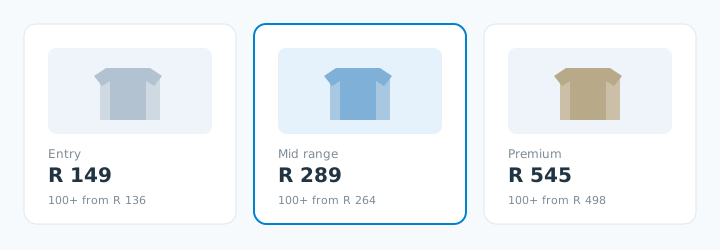
Show a volume break. "R289 each, from R264 at 100" tells a buyer the price moves with quantity, so they ask about quantity instead of arguing about the unit price.
Keep branding out of the shelf price. Price the garment, and let branding be quoted, because it genuinely is a separate calculation. Our article on what branding actually costs covers why it cannot sit in a shelf price.
Show stock. A price without availability is half an answer, and it is the half that causes the phone call.
Let the buyer build the order themselves. When a customer can put 40 navy and 60 white across five sizes into one grid and see the total move, the price stops being a single number to argue with and becomes an order to place.
The quantity grid matters because it turns a general price check into a properly specified enquiry. By the time the request reaches you, the customer has already supplied the size and colour breakdown.
If you are still deciding
Publish prices on your stock range for one quarter and count two things: how many enquiries you get, and how many of them turn into orders. The second number is the one that matters, and it is the one most resellers have never counted.
If the ratio improves, you have your answer. If it does not, take the prices down. It is a website, not a printed catalogue.
Questions we get asked about this
Will my competitors undercut me if I publish?
They can already work out your pricing by asking you to quote, and most of them have. What publishing changes is that a buyer can see your price without contacting anybody, which is the same advantage your competitor gets from your quote.
Does publishing stop customers phoning me?
It stops the calls that were only ever asking the price. The calls you want, about a specific job with a deadline, go up, because the person calling has already decided you are in range.
Can I publish some prices and not others?
Yes. You can publish prices on stock lines that are easy to compare and keep job-specific work on a quote basis where the specification changes the final number.
What about VAT?
Show the price including VAT first and the excluding figure beneath it. Business buyers can read either, but a price that turns out to be 15% higher at the quote stage costs you trust you did not need to spend.
Last updated 9 September 2026. Sources and limits.
Put the catalogue on your own website
CatalogueConnect builds Amrod reseller websites with catalogue sync, reseller-controlled pricing and a bulk quantity grid. The website build is R18 999 once off.