On this page
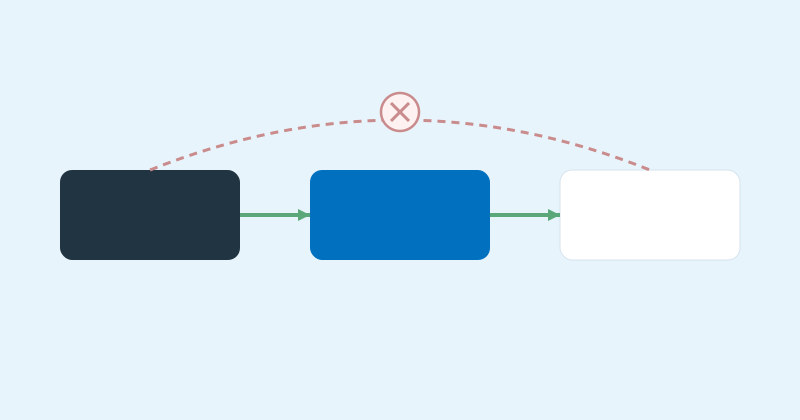
Margin disappears in four ordinary places, plus one structural pricing mistake. The four are a second print position, artwork that has to be redrawn, a rush deadline and a second delivery address. The fifth, quoting one order as several, costs more than all four together.
Where the margin goes
Margin can disappear in four ordinary places, plus one structural pricing mistake. The four are a second print position, artwork that has to be redrawn, a rush deadline and a second delivery address. The structural mistake is quoting one order as several.
None of them is exotic. That is the problem: they are ordinary enough to forget, and each one is absorbed quietly by whoever quoted the job.
How branding is actually charged
Two charges sit on top of the garment, and they behave differently from each other.
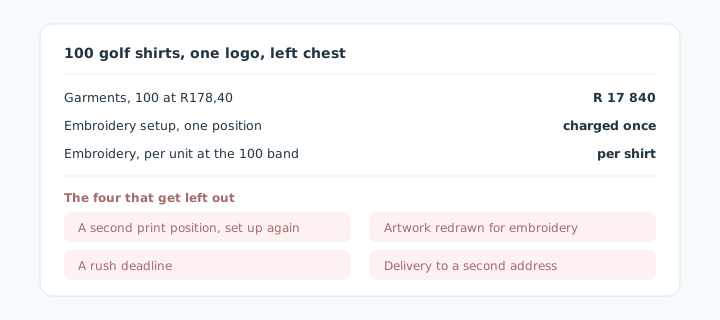
A setup fee for each print position. Whatever your supplier calls it, it pays for preparing that logo, in that position, for that method. It is charged for the position, not per unit, which is why branding is expensive on twenty shirts and barely noticeable on two hundred.
A per-unit charge that falls into quantity bands. More units, lower rate each. The band that applies is decided by the quantity on the line being priced, which becomes important in a moment.
The four costs that get left out
The second position. The customer asks for the logo on the chest and something small on the sleeve. That is two positions, two setups, two per-unit charges. It is agreed in a phone call, it never reaches the quote, and it is the single most common one.
Artwork that has to be redrawn. Most logos arrive as a picture, not as artwork. A picture cannot be stitched, so somebody converts it, and that costs money and a day. Covered properly below.
The rush. "We need them for the golf day on the 14th" changes the price, and it is almost never in the quote because it arrives as a comment rather than a requirement.
The second address. Half to head office and half to the branch is two deliveries. It sounds like an administrative detail, and it is a line item.
The mistake that costs more than all four
A customer wants 100 shirts: 40 navy, 35 white, 25 grey, spread across sizes. In their head that is one order for 100 units.
If it is entered as three separate lines, one per colour, it can attract three setup fees instead of one, and each line gets priced in a lower quantity band, so the per-unit branding rate is worse on all three.
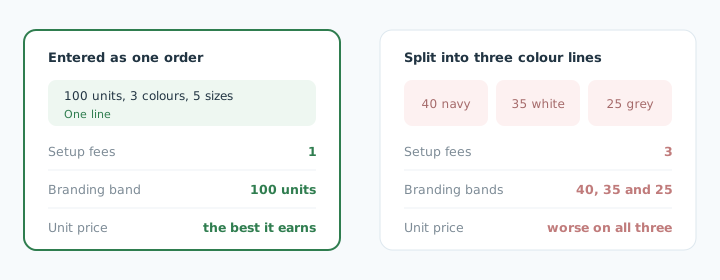
This is often a system problem rather than a staff problem. If the ordering tool breaks one customer order into separate lines, the pricing logic starts from the wrong grouping.
Most online shops are built for someone buying one thing: pick a colour, pick a size, add to cart. A spread order through that flow becomes fifteen separate cart lines, and everything downstream treats them as fifteen things. The customer either does fifteen add-to-carts or gives up and sends an email, which is why so many promotional sites produce enquiries instead of orders.
The fix is to capture the whole order in one action: colours down the side, sizes across the top, quantities in the boxes, one total at the bottom. One order, one setup, the right band.
What good artwork looks like
Artwork arrives in three states and only one of them is free.
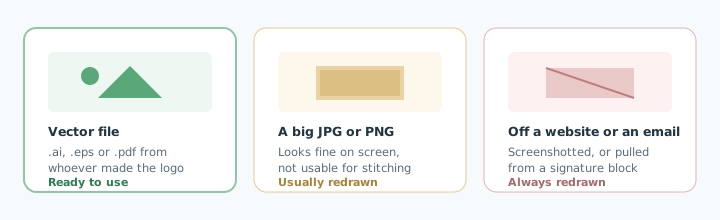
A vector file is the logo as the designer built it, in lines rather than pixels. It scales to any size and it is ready to use.
A large image file looks perfect on a screen and is still made of pixels. For most branding methods somebody has to trace it back into lines first.
A logo off a website or an email signature always needs redrawing. It is small, it is compressed, and it usually has a white box behind it.
One question at quoting time saves the whole problem: "do you have the original logo file from your designer?" If the answer is no, add the redraw to the quote before the customer has decided you are the cheap option.
Which method, and why it changes the number
Customers ask for "branding" and mean five different things. The method decides both charges, so pinning it down early is worth more than any other question you ask.
Embroidery suits garments and headwear, lasts, and looks expensive because it is. The logo is digitised once into stitch instructions, and that setup carries across the run. Fine detail and thin text are its weakness: small lettering fills in and comes back looking like a smudge.
Screen printing is the workhorse for larger runs on flat surfaces. Each colour in the logo is a separate screen, so a two-colour logo costs less to set up than a five-colour one. Below about fifty units the setup dominates and something else is usually cheaper.
Pad printing handles the small curved things: pens, mugs, torches. Cheap per unit, limited print area, and colour matching is less exact than a customer expects when they hand you a brand guideline.
Digital and full-colour transfer takes photographs and complicated logos that screen printing would struggle with. Better on short runs because there is little setup, worse per unit at volume.
Laser engraving marks metal and some hard surfaces permanently, in whatever colour the material goes when it is burned. Customers asking for their brand colour on a metal flask are usually surprised by this, and it is better to say so at quoting time.
The practical rule: ask what the item is, how many, and how many colours are in the logo. Those three answers narrow the method to one or two, and the method is what the price hangs on.
A checklist before you send the quote
Six questions. They take a minute and they are the difference between a job that pays and one that does not.
- How many print positions, including anything mentioned in passing?
- Which branding method, and has this logo been set up in that method before?
- What state is the artwork in, and have I seen the file?
- Is the whole quantity being priced as one order, or has it been split by colour?
- Is there a deadline that makes this a rush?
- How many delivery addresses?
The fourth one is the expensive one, and it is the only one on the list that a better tool fixes for you rather than a better habit.
The point
You are not losing margin because your prices are wrong. You are losing it because the quote was built before some of the facts arrived, and because the order got chopped up on the way in.
Fix the capture and most of it stops happening on its own.
Questions we get asked about this
Is the setup fee charged per order or per colour?
Per print position, on the order. The trap is that splitting one order into three colour lines can create three orders in the supplier's eyes, and then the fee applies to each.
Why does embroidery cost more than print on small runs?
Because digitising the logo for stitching is a once-off cost carried by however many units are in the run. On 20 shirts it is significant per unit. On 200 it disappears.
Should I quote branding separately from the garment?
Yes. The garment has a stable price, branding depends on position, method, colours and quantity. Separating them lets you publish garment prices and keep the branding conversation where it belongs.
What is digitising?
Converting a logo into stitch instructions an embroidery machine can read. It is done once per logo per size, and it is not the same as having a good-quality image.
Last updated 9 September 2026. Sources and limits.
Put the catalogue on your own website
CatalogueConnect builds Amrod reseller websites with catalogue sync, reseller-controlled pricing and a bulk quantity grid. The website build is R18 999 once off.