On this page
No. Amrod is trade only and does not supply end users, so your customer cannot open an account or get a price. The risk that is real is different: they buy from another reseller, and they find that reseller the same way they find everything else.
No, and the risk that matters is elsewhere
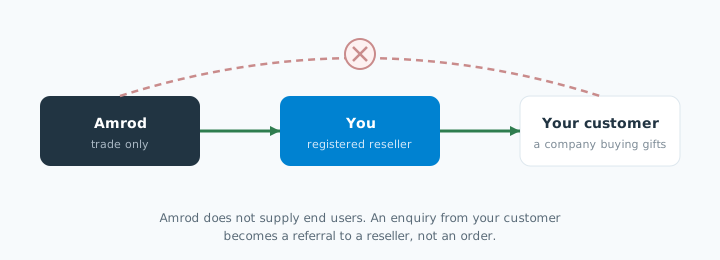
No. Amrod is trade only and does not sell to end users. Your customer cannot open an account, cannot order, and cannot get a price from them.
The remaining issue is not whether the end customer can open a normal buying account with Amrod. It is which reseller the customer deals with when they need to buy the product.
What Amrod says about end users
Amrod states its position plainly on its own registration page. It supplies registered and approved resellers, and it says directly that it does not sell to end users, corporates, individuals or once-off buyers. To register you have to show that reselling promotional products is your core business, and applications are vetted before an account is opened.
Amrod states this on its reseller registration information. Its account model is built around supplying registered and approved resellers rather than end users.
What happens when your customer enquires
Say a procurement officer at one of your clients finds the range online and contacts the supplier directly.
She is told the company sells to registered resellers only, and she is pointed at one. She does not get a price, she does not get an account, and she has spent twenty minutes finding out that she needs somebody like you.
The question is which reseller she is pointed at, or which one she finds next. That is the part you can influence, and it has nothing to do with hiding your supplier.
So why does it still feel risky?
Because in this trade the catalogue genuinely is dangerous to hand over, and everyone knows it.
Your supplier catalogue shows your cost, against your own account tier. Email that PDF to a customer and you have shown them your buying price and your margin in one attachment. Twenty years of being careful about that builds an instinct, and the instinct does not distinguish between the catalogue and a website.
It should. A properly built website shows your selling price and nothing else. Your cost stays on your own server, behind your login, and is never sent to a browser. Our article on whether to publish prices goes through exactly what is and is not exposed.
The risk that is real
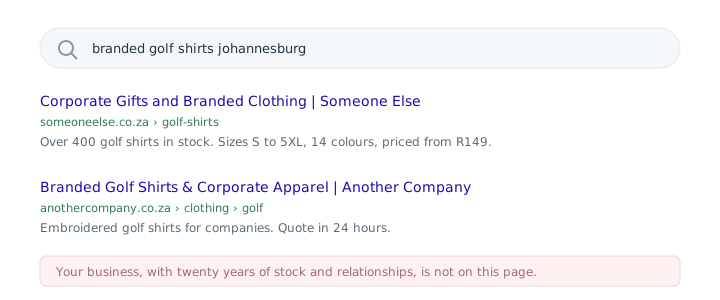
Your customer is not going to buy from your supplier. They are going to buy from another reseller, and they are going to find that reseller the same way they find everything else.
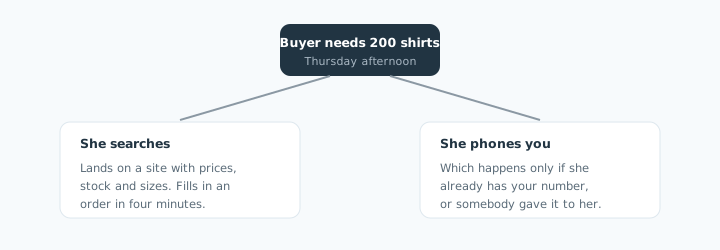
A buyer who needs 200 shirts on a Thursday afternoon has two routes. She phones somebody she already knows, or she searches. If she knows you, you are fine. If she does not, the reseller with a website carrying prices, stock and sizes gets a four-minute enquiry, and you never hear about the job at all.
That type of lost opportunity is difficult to measure because the buyer may never contact you. If your business is not visible when they search for the product, you are not part of the comparison.
What to do about it
Be findable for what you sell. Not for your company name, which only people who already know you type. For the products: golf shirts, hoodies, branded drinkware, corporate gifts, and the town you are in.
Show the range with prices and stock. A buyer comparing three suppliers will get a number from two of them today and from you on Monday. Monday is too late, and it was never about the price.
Make it easy to place a real order. Somebody who can put their sizes and colours into a grid and see a total has effectively written you a purchase order. Somebody who has to email a request has to remember to do it.
Keep the sale focused on your business. If the customer needs supplier information for procurement, give them what is required. Otherwise the useful conversation is about the product, price, branding, delivery and who is responsible for the order.
What to say when a customer asks who your supplier is
A procurement team may ask where products come from for legitimate supplier-vetting reasons. Answer the question at the level they need.
If they are checking capability, answer with the range. Explain the categories you can supply and whether the requested product is available through your trade accounts.
If they are checking responsibility, answer with your process. Make it clear that the customer buys from your business and that you remain responsible for the quote, order and delivery.
If they need compliance information, give them the required paperwork. Larger companies may need company, tax or supplier-vetting documents before they can place an order.
What this means for a reseller
Your supplier is not the part you need to compete with. The practical competition is another reseller who can show the range, answer the buyer's questions and respond faster.
Questions we get asked about this
Can a company open its own Amrod account?
Only if its core business is reselling promotional products. Amrod says on its registration page that it does not sell to end users, corporates, individuals or once-off buyers, and applications are vetted before an account is opened.
Will Amrod tell my customer what I paid?
Amrod does not publish reseller cost prices to the public, and your cost depends on your own account tier. What a customer can find is the range, not your buying price.
Should I hide which supplier I use?
You do not need to make the supplier the centre of the sale. Your customer is buying from you, so the useful information is the range you can supply, your price, your service and who takes responsibility for the order.
What if my customer sees the range on a supplier website?
Seeing the supplier range does not turn an end customer into a normal trade buyer. They still need a reseller to quote and supply the order.
Last updated 9 September 2026. Sources and limits.
Put the catalogue on your own website
CatalogueConnect builds Amrod reseller websites with catalogue sync, reseller-controlled pricing and a bulk quantity grid. The website build is R18 999 once off.