On this page
The pricing work is about twenty minutes. The elapsed time is usually two days, and the gap is almost entirely waiting: for the size breakdown, for a stock check, and for the job to reach the top of the pile again.
Twenty minutes of work, two days of waiting
The pricing work can be about twenty minutes, while the elapsed time becomes two days. The gap comes from the number of times the job stops for missing information, another task or a reply from the customer.
That gap is worth counting, because it is costing you both staff time and orders, and almost nobody in this trade has ever put a number on either.
Where two days actually go
Take a straightforward enquiry: two hundred hoodies, one logo, from a company that has bought from you before.
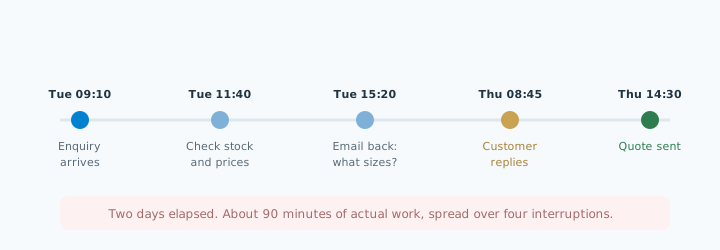
Notice what actually consumed the two days. Not the pricing. The waiting: waiting to get to it, waiting for the customer to answer a question you had to ask because they did not know to include it, waiting to get back to it once they did.
The single biggest delay in most quotes is the size breakdown. The customer asks for "200 hoodies", you cannot price 200 hoodies without knowing the split, so you ask, and the clock stops for a day and a half.
What that costs you a month
Take a minute and work out your own figure. Most people are surprised by it.
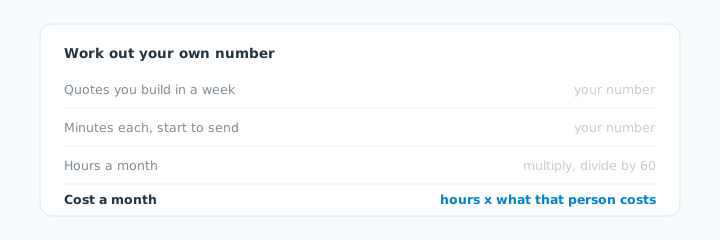
Count the quotes you build in a week, and count the minutes each one takes from opening the enquiry to sending the number. Include the interruptions, because they are the real cost. Multiply out to a month, then multiply by what the person doing it costs you an hour.
The point is to put a real cost against quoting time, including the quotes that never become orders.
Why the fast quote wins
Buyers rarely ask one supplier. They ask three, on the same morning, and then they get on with their day.
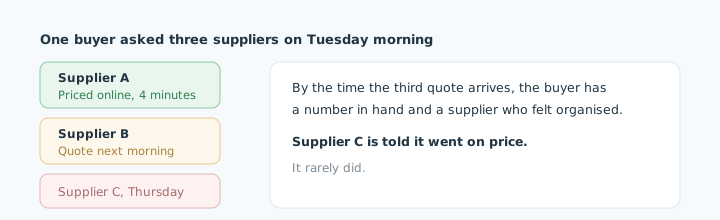
By Thursday, the buyer has a number from someone else, has mentally started planning around it, and has formed an impression of who is organised. Your quote arrives into a decision that has already leaned.
Price still matters, but response time changes when the buyer can start comparing real options. A late quote can arrive after the practical decision has already moved on.
What actually makes it slow
Four things, in roughly this order of cost.
You have to ask for the size breakdown. The customer sent a total. You need the split. That single missing fact costs a day more often than anything else on this list.
You have to check stock. Not because it is difficult, but because it means leaving the quote, going somewhere else, and coming back with a number that is already slightly old.
You have to build the pricing by hand. Cost, markup, volume break, VAT, and then the same again if they change the quantity. Every rebuild is another opportunity for an error you will honour.
It sits in a queue behind live orders. Which is correct, because live orders pay. It is also why the quote that could have taken twenty minutes takes two days.
How to get it under an hour
Stop asking for the size breakdown. Let the customer give it to you at the point they make the enquiry, in a grid: colours down the side, sizes across, quantities in the boxes. It takes them four minutes and it removes the day and a half.
Let the price build itself. If your cost, your markup rule and your volume break are already set up, the arithmetic is not a task anybody needs to do. It is a lookup.
Show stock while they are choosing. The customer sees a size is short before they ask for it, which means it is handled in their heads instead of in a phone call from you.
Keep the exceptions. Rush jobs, unusual artwork and multi-position branding still deserve a human quote. They are the minority, and they are worth your time, which you now have.
The enquiry that arrives with nothing in it
"Hi, can you give me a price on hoodies?" No quantity, no colours, no sizes, no deadline, no logo.
Two common responses both cost time. They reply with a list of questions, which starts the two-day cycle. Or they guess at a spec and quote it, which produces a number the customer cannot use and often will not reply to.
A more useful first reply is a price range followed by the one or two questions that materially change the quote.
"Hoodies run from about R285 to R640 depending on weight and brand. For a hundred with a chest logo you would be looking at the lower end. How many are you thinking, and roughly when do you need them?"
That reply does four things in three sentences. It gives a real number, so the customer can tell immediately whether you are in their range. It shows you know the category. It asks for the two facts that actually change the answer. And it arrives in four minutes rather than two days.
If they are shopping on price, the range filters them out now instead of after you have built a full quote. If they are serious, you have started the conversation with something useful in it.
This is also the argument for having your range online with prices on it. Half of the thin enquiries you get exist only because the person had no way to find a number themselves, and every one of them costs you a reply.
What this means for quoting
A quote can lose before price is properly compared if another supplier gives the buyer a usable answer first.
The quotes worth your judgement are the complicated ones. The 200-hoodies-in-three-colours enquiry is not one of them, and it should not be eating a Tuesday.
Questions we get asked about this
Is same-day quoting realistic in this trade?
For stock items with a known branding method, yes. For a job needing artwork assessment, an unusual product or a supplier stock call, a same-day acknowledgement with a next-day quote lands better than silence.
Should I quote from a price list or check every time?
Check every time, or use something that checks for you. Trade prices move, stock moves faster, and a quote built from a three-month-old spreadsheet is the one that turns into an apology.
What if I quote fast and get the price wrong?
That is the real risk, and it is why speed has to come from removing steps rather than from rushing them. A quote assembled by hand at speed is where mistakes come from; one assembled from live prices is not.
Does the customer really care about speed?
They care about certainty. A number on Tuesday lets them plan; a number on Thursday arrives after they have started planning around somebody else.
Last updated 9 September 2026. Sources and limits.
Put the catalogue on your own website
CatalogueConnect builds Amrod reseller websites with catalogue sync, reseller-controlled pricing and a bulk quantity grid. The website build is R18 999 once off.